
Slewing Ring Bearings in Wind Turbines: Applications and Engineering Considerations
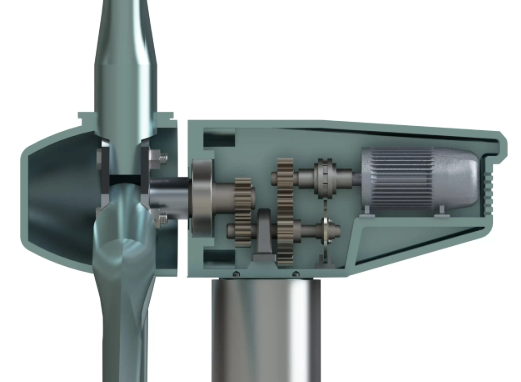
Wind turbines operate under demanding conditions. Large and continuously changing loads, variable wind speeds, vibration, temperature fluctuations, and long operating cycles place significant stress on their mechanical systems. Among the components responsible for reliable rotational movement, the Slewing Ring Bearing plays an important role in supporting loads and enabling controlled rotation.
As wind turbines continue to grow in size and power capacity, the engineering requirements for their bearing systems are becoming increasingly demanding. Bearing rings must deliver high load-carrying capacity, dimensional accuracy, fatigue resistance, and long-term reliability.
A high-quality Seamless Rolled Ring can provide the structural foundation required for demanding bearing applications. The quality of the ring manufacturing process, material selection, heat treatment, machining, and inspection all influence the final performance of the bearing.
In this guide, we explore how slewing ring bearings are used in wind turbines, the engineering considerations involved in their design and manufacturing, and why high-quality seamless rolled rings are important for reliable wind energy equipment.
What Is a Slewing Ring Bearing?
A slewing ring bearing is a large-diameter rotational bearing designed to support axial loads, radial loads, and overturning moments while allowing one component to rotate relative to another.
Unlike conventional bearings that are generally used for high-speed rotation, slewing bearings are designed for applications where:
- Large diameters are required
- Heavy loads must be supported
- Rotational speeds are relatively low
- Space is limited
- High structural rigidity is important
A typical slewing bearing assembly consists of:
- Inner ring
- Outer ring
- Rolling elements
- Raceways
- Seals
- Gear teeth in geared configurations
- Lubrication system
In wind turbine applications, these bearings can be incorporated into different turbine systems depending on the turbine architecture and design requirements.
Why Are Slewing Ring Bearings Important in Wind Turbines?
A modern wind turbine must continuously respond to changing wind conditions. The turbine’s mechanical systems therefore need to handle dynamic loads while maintaining accurate positioning and smooth movement.
A Slewing Ring Bearing can provide the combination of rotational capability and structural support needed for large wind turbine assemblies.
Depending on turbine design, slewing bearing technology can be used in applications such as:
- Yaw systems
- Pitch systems
- Rotor positioning mechanisms
- Other large rotational interfaces
The specific bearing configuration depends on the turbine’s architecture, load requirements, operating environment, and control strategy.
Applications of Slewing Ring Bearings in Wind Turbines
1. Yaw System Applications
The yaw system rotates the nacelle so that the rotor remains aligned with the direction of the wind.
A large slewing bearing can form a critical part of this rotational interface.
The bearing must withstand:
- Axial loads
- Radial loads
- Tilting moments
- Wind-induced dynamic forces
- Repeated rotational cycles
Reliable yaw bearing performance is important because inaccurate positioning can affect turbine efficiency and increase mechanical stress.
2. Pitch System Applications
Pitch systems adjust the angle of the turbine blades to control aerodynamic performance.
Pitch bearing assemblies operate under highly variable loads and repeated movement. Their engineering requirements can include:
- High fatigue resistance
- Precise rotational movement
- Dimensional stability
- High load capacity
- Long operating life
The bearing rings must therefore be manufactured from suitable materials and processed under tightly controlled conditions.
3. Large Rotational Interfaces
Beyond conventional yaw and pitch applications, large ring-bearing technologies can be considered for specialized rotational interfaces in wind energy equipment.
As turbine designs become larger, engineers increasingly focus on:
- Bearing stiffness
- Load distribution
- Ring geometry
- Raceway performance
- Lubrication
- Fatigue life
- Manufacturing accuracy
These factors directly affect equipment reliability and maintenance requirements.
The Role of Seamless Rolled Rings in Wind Turbine Bearings
The ring is one of the most important structural elements of a large bearing. Its manufacturing quality has a direct influence on the performance and service life of the final assembly.
A Seamless Rolled Ring is produced through a controlled forging and ring rolling process rather than by joining separate pieces through welding.
A typical manufacturing route may involve:
- Selection of suitable raw material
- Heating
- Forging
- Piercing
- Ring rolling
- Heat treatment
- Machining
- Inspection and testing
The controlled deformation achieved during forging and rolling can produce favorable grain flow and strong structural integrity.
For demanding wind turbine applications, these characteristics can be particularly valuable.
See also: Northern Ontario Nature Retreats Are Helping Travelers Rediscover the Joy of Slowing Down
Why Seamless Rolled Rings Are Preferred for Large Bearing Applications
Large bearing rings require consistent material properties and dimensional stability. Seamless ring manufacturing offers several potential advantages.
Improved Structural Integrity
A seamless forged ring avoids the welded joint associated with fabricated ring construction.
Favorable Grain Flow
The forging and rolling process can help develop grain flow around the ring geometry, supporting mechanical performance.
High Load-Carrying Capability
Properly engineered and processed ring forgings can withstand significant radial, axial, and moment loads.
Fatigue Resistance
Wind turbines experience millions of operational load cycles. Material quality and manufacturing control are therefore critical to achieving the required fatigue performance.
Better Material Utilization
Ring rolling can produce large-diameter components efficiently while reducing the material waste associated with machining a complete ring from a large solid block.
Engineering Considerations for Slewing Ring Bearings in Wind Turbines
Designing a reliable bearing for a wind turbine requires more than selecting a bearing based on diameter. Engineers must evaluate multiple interacting parameters.
1. Load Capacity
Wind turbine bearings experience different combinations of:
- Axial loads
- Radial loads
- Tilting moments
- Dynamic loads
- Shock loads
The bearing and ring structure must be designed to handle the expected load spectrum throughout the intended service life.
2. Fatigue Life
Wind turbines operate continuously for long periods. Their bearings are subjected to repeated loading and unloading cycles.
Engineers must therefore evaluate:
- Raceway contact stresses
- Rolling-element loads
- Material fatigue properties
- Load distribution
- Operating cycles
A high-quality ring forging is an important part of establishing reliable fatigue performance.
3. Material Selection
The material selected for a bearing ring must provide an appropriate combination of:
- Strength
- Toughness
- Hardness
- Fatigue resistance
- Heat-treatment response
Alloy steels are commonly considered for demanding bearing applications because their properties can be tailored through appropriate heat treatment.
The correct material grade should always be selected according to the bearing design, load requirements, operating environment, applicable standards, and manufacturer’s engineering specifications.
4. Heat Treatment
Heat treatment is a critical stage in bearing ring manufacturing.
Depending on the material and application, processes may include:
- Normalizing
- Quenching
- Tempering
- Surface hardening
- Induction hardening
The objective is to achieve the required combination of core toughness and surface hardness.
For bearing raceways, controlled hardening is particularly important because the raceway surface experiences repeated rolling contact.
5. Dimensional Accuracy
Large slewing bearings require tight control over critical dimensions.
Important characteristics include:
- Ring diameter
- Raceway geometry
- Roundness
- Concentricity
- Flatness
- Raceway alignment
- Gear geometry where applicable
Dimensional deviations can influence load distribution, friction, vibration, and service life.
This is why precision machining and inspection are essential after the forging and rolling stages.
6. Raceway Quality
The raceway is the contact surface between the rolling elements and the bearing ring.
Its condition directly affects:
- Contact stress
- Friction
- Wear
- Lubrication behavior
- Fatigue life
Manufacturers must therefore carefully control material properties, heat treatment, machining accuracy, and surface condition.
7. Lubrication
Proper lubrication reduces friction and protects the bearing against wear and premature damage.
Wind turbine bearings may operate under:
- Variable loads
- Low temperatures
- Moisture
- Dust
- Long maintenance intervals
The lubrication system must therefore be selected and maintained according to the bearing design and operating environment.
8. Environmental Conditions
Wind turbines are frequently installed in challenging environments.
Onshore turbines may encounter:
- Dust
- Temperature fluctuations
- Rain
- Humidity
- Contaminants
Offshore turbines face additional challenges such as:
- Salt spray
- High humidity
- Corrosive environments
- Difficult maintenance access
Bearing materials, seals, coatings, lubrication, and corrosion protection should therefore be selected according to the installation environment.
9. Corrosion Protection
Corrosion can negatively affect bearing performance and service life.
For wind turbine applications, manufacturers may use appropriate:
- Surface treatments
- Protective coatings
- Seal systems
- Corrosion-resistant materials
- Maintenance procedures
The right corrosion protection strategy depends on the turbine location and operating environment.
=
Manufacturing Process of a Seamless Rolled Ring for Bearing Applications
Producing a high-quality Seamless Rolled Ring requires controlled manufacturing at every stage.
Step 1: Raw Material Inspection
The incoming steel is checked for chemical composition, traceability, and required material properties.
Step 2: Heating
The material is heated within a controlled temperature range appropriate for the selected alloy.
Step 3: Forging and Piercing
The heated material is forged and pierced to create the initial ring-shaped preform.
Step 4: Ring Rolling
The preform is progressively rolled to increase its diameter while controlling wall thickness and geometry.
Step 5: Heat Treatment
The ring undergoes the specified heat treatment cycle to achieve the required mechanical and metallurgical properties.
Step 6: Machining
Precision machining produces the required dimensions, raceway profiles, mounting surfaces, and other features.
Step 7: Inspection
The finished ring is inspected using appropriate dimensional, metallurgical, and non-destructive testing methods.
This controlled process helps ensure that the ring meets the requirements established for the final bearing application.
Quality Testing for Wind Turbine Bearing Rings
Because wind turbine bearings are critical components, quality assurance is essential.
Depending on customer specifications and applicable standards, inspection may include:
Chemical Analysis
Confirms the material composition.
Ultrasonic Testing
Helps identify internal discontinuities within the forged ring.
Magnetic Particle Inspection
Can identify surface and near-surface discontinuities in suitable ferromagnetic materials.
Hardness Testing
Confirms that the material and heat treatment meet specified hardness requirements.
Dimensional Inspection
Verifies critical dimensions and geometric tolerances.
Metallurgical Examination
Can be used to evaluate grain structure and microstructural characteristics.
A robust quality management system ensures that defects are identified before the component reaches final assembly.
Common Manufacturing Challenges in Large Bearing Rings
Manufacturing large rings for wind turbines requires careful process control.
Potential challenges include:
- Uneven heating
- Non-uniform deformation
- Residual stresses
- Dimensional distortion during heat treatment
- Raceway machining errors
- Material discontinuities
- Insufficient surface hardness
- Poor dimensional control
Experienced manufacturers address these risks through process monitoring, controlled heat treatment, forging expertise, precision machining, and comprehensive inspection.
Why Manufacturing Expertise Matters
The performance of a wind turbine bearing does not depend solely on its design. The manufacturing quality of its individual components is equally important.
A capable Seamless Rolled Ring manufacturer should understand:
- Forging metallurgy
- Ring rolling
- Heat treatment
- Material selection
- Dimensional control
- Non-destructive testing
- Application-specific requirements
For wind energy applications, close cooperation between the bearing manufacturer, ring manufacturer, and turbine OEM can help ensure that the component meets its intended performance requirements.
Why Choose Akron Ring Forge for Seamless Rolled Rings?
Akron Ring Forge specializes in the manufacturing of precision-engineered rolled rings for demanding industrial applications.
Our expertise in Seamless Rolled Ring manufacturing is focused on delivering components where strength, dimensional consistency, and material integrity are essential.
Our manufacturing approach is designed to support applications requiring:
- High-strength forged rings
- Large-diameter ring components
- Consistent material properties
- Controlled manufacturing processes
- Application-specific engineering
- Reliable quality inspection
For wind energy and other heavy engineering applications, Akron Ring Forge works to provide ring solutions designed around the technical requirements of the application.
The Future of Slewing Ring Bearings in Wind Energy
Wind turbines are becoming larger, taller, and more powerful. As turbine capacity increases, the loads acting on mechanical components also increase.
Future bearing development is expected to focus increasingly on:
- Higher load capacity
- Longer fatigue life
- Improved sealing
- Better corrosion protection
- Lower maintenance requirements
- Advanced monitoring
- Improved manufacturing precision
The demand for high-quality forged and rolled rings will continue to grow alongside these developments.
For manufacturers, this means maintaining strong control over metallurgy, forging, ring rolling, heat treatment, machining, and inspection will remain essential.
Conclusion
Slewing Ring Bearings are critical components in many wind turbine systems because they allow controlled rotation while supporting substantial loads and moments. As turbine sizes increase, bearing rings must deliver greater strength, fatigue resistance, dimensional accuracy, and long-term reliability.
A high-quality Seamless Rolled Ring provides a strong foundation for large bearing applications because controlled forging and ring rolling can produce favorable material flow and structural integrity.
However, the final performance depends on the entire manufacturing chain — from material selection and forging through heat treatment, machining, inspection, and quality assurance.
For wind turbine manufacturers and industrial bearing suppliers looking for dependable forged ring solutions, working with an experienced ring manufacturer can help achieve the consistency and performance required for demanding applications.
Looking for a Reliable Seamless Rolled Ring Manufacturer?
Akron Ring Forge provides engineered rolled ring solutions for demanding industrial applications.
If you have a requirement for large-diameter rings, bearing rings, or custom forged components, contact Akron Ring Forge to discuss your material, dimensions, application, and performance requirements.
Build your next critical component on a stronger manufacturing foundation with Akron Ring Forge.